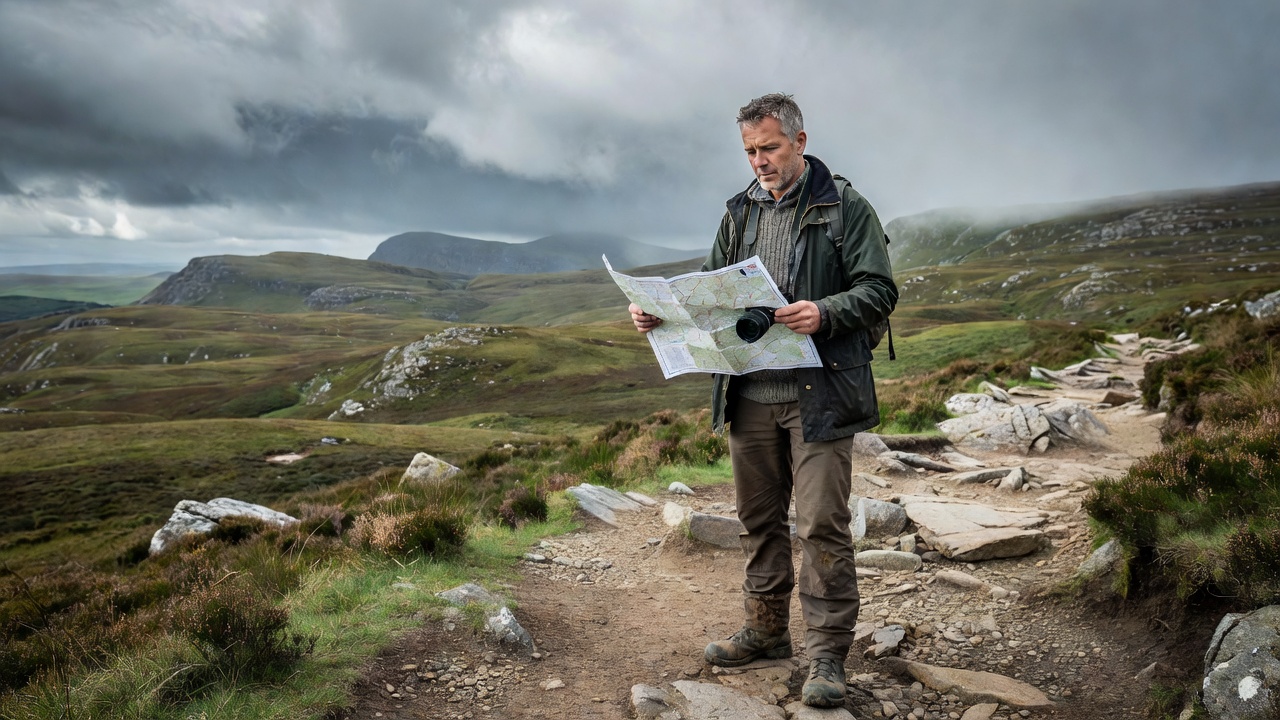
Online location lists often collapse a journey into a pin. The pin does not show a seasonal closure, a field in active use, a nesting area or a steep slope hidden just outside the frame. A stronger scouting method starts with the landscape as a whole and works towards a permitted position, rather than starting with a photograph and trying to reproduce its exact camera placement.
Choose what interests you: overlapping ridges, a river bend, a changing shoreline or the relationship between settlement and terrain. That subject can usually support more than one viewpoint. Giving yourself several compositional options makes it easier to respect a boundary when the first position proves unsuitable.
Establish access before analysing the light
Read official maps and information from the relevant park, municipality, route organisation or land manager. A mapping application may show a track without establishing a right to use it. Access laws differ between countries and can depend on the activity, the land type and local restrictions. Do not assume that a rule familiar from home applies elsewhere.
Where permission is unclear, ask a responsible local source or choose a clearly authorised alternative. Never climb a fence, ignore a closure or use a gap in a wall as evidence that entry is welcome. A viewpoint can be geographically public-looking while its approach crosses private or sensitive ground.
Four places, four planning lessons
Slovenia’s Julian Alps offer valley and mountain compositions, but a modest distance on a map can involve substantial ascent or exposed terrain. Use current information from the relevant local authorities and, where applicable, Triglav National Park. Select a route that suits the least experienced member of your group, not merely the photographer carrying the lightest bag.
Croatia’s Velebit range illustrates how terrain and exposure can change a seemingly straightforward lookout. Wind, rocky ground and protected-area rules deserve careful attention. A maintained viewpoint may provide a better working position than a higher point reached by an informal line. Treat local warnings as part of the route description, not optional background.
In Portugal’s Alentejo, a landscape photograph might depend on cultivated land, rural roads and a distant settlement rather than a dramatic summit. Keep vehicles clear of entrances, remain on permitted routes and avoid treating farm operations as scenery arranged for visitors. Ask before photographing people closely or entering working spaces.
Assynt in northwest Scotland is a useful reminder that familiar hill shapes do not make every approach simple. Boggy ground, variable visibility and long road journeys influence the day. Apply the Scottish Outdoor Access Code, heed local notices and avoid damaging soft ground for a slightly lower camera position. Legal access and low-impact behaviour belong together.
Predict the light, then test the prediction
Use a map to understand the direction your subject faces and the position of intervening ridges. A sunrise time alone does not tell you when direct light will reach a valley. Terrain can delay illumination, while cloud may turn a carefully planned beam of light into a more even scene.
If practical, scout in daylight before returning for an early or late session. Identify secure footing and the return route while you can see them clearly. Do not make darkness part of the plan unless your skills, equipment and route support safe travel in it. A headlamp is useful equipment, not a substitute for navigation ability.
Change the composition before changing the boundary
From a permitted position, try a longer lens to isolate layers, lower the camera on firm ground, or turn away from the expected direction. A viewpoint rarely offers only one photograph. Side light on nearby grass, a patch of moving cloud or the edge of a village may communicate more than a broad panorama.
Keep the path open. Do not spread bags and tripod legs across a narrow route, and be ready to move for walkers or local users. Avoid placing companions on skyline edges or fragile features for scale. If a photograph depends on another person accepting unnecessary risk, the composition needs to change.
Publish with the next visitor in mind
Broad destination context can help readers learn without directing concentrated attention to a sensitive feature. Avoid sharing exact coordinates for vulnerable habitats, unregulated informal paths or culturally sensitive places. Explain restrictions alongside the photograph, and do not present an image as proof that current access is available.
Responsible scouting is not a restriction on curiosity. It is a way to keep curiosity useful: more observation, better questions and fewer assumptions about what a beautiful place owes the camera.